If you’ve ever wanted to read math literature during your math block and didn’t know where to start? Keep reading to see how I bridge the gap between math and literature! It can be so fun and engaging!
Which Math Literature Will I Share?
1.) The Button Box
2.) Counting Gumballs
3.) Apple Countdown
4.) Trick or Treat Countdown
5.) Pumpkin Countdown
6.) Bat Jamboree
7.) 5 Little Bats Flying in the Night
8.) 10 Timid Ghosts
9.) Spookley the Square Pumpkin
10.) Stellaluna
11.) Bone Soup
The Purpose Behind My Activities:
I love reading math literature with my first graders. I teach them that math literature can also improve and grow their schema. So we touch our schema and we say, “Why is the story about math?”
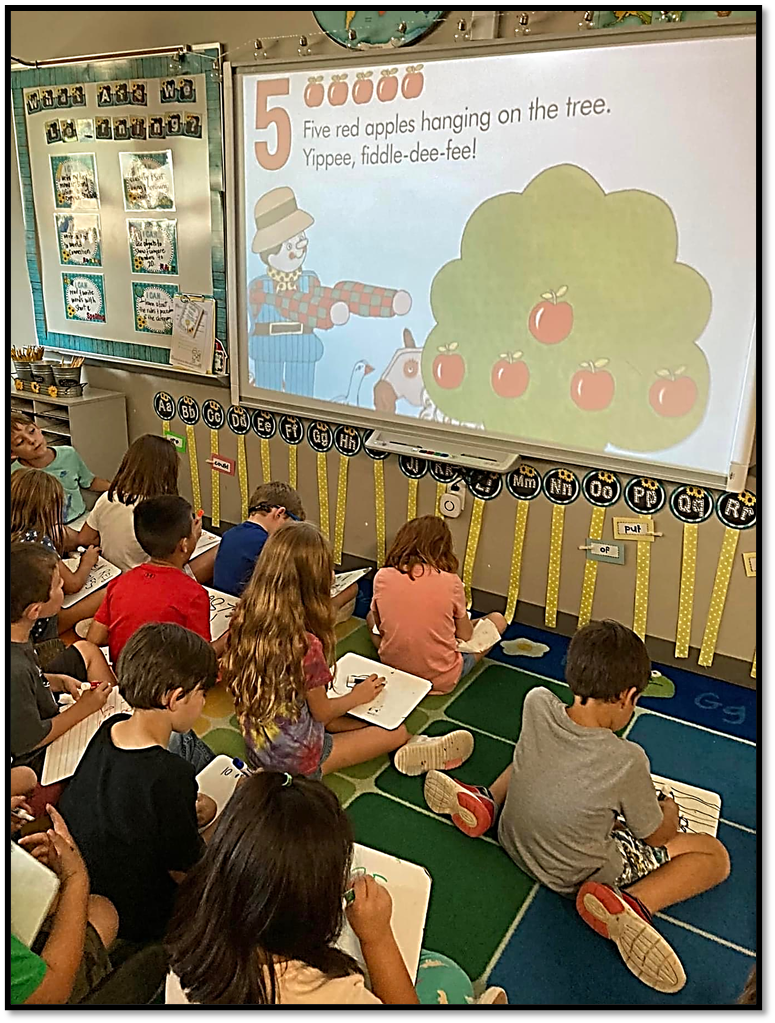
When my students come in from lunch, they get their whiteboard, their Expo marker, and a tissue, and they all come sit on the carpet. I either read them a math story, or they listen to it on YouTube. If I don’t have the book, then we listen to it. And sometimes I like to alternate, you know, I go back and forth. I think it’s important to have the students listen to other voices and not just mine all the time.
I tell them that they are going to write down any numbers that they hear from the story. They’re writing down any numbers. So the whole time they’re listening to the story, I’m watching them write down their numbers. At the end of the story, I ask them if the numbers were increasing or decreasing. And they have to tell me why. How do they know? They’re increasing because the numbers are getting bigger, or they’re decreasing because the numbers are getting smaller.
And then I tell them, pick a number. Whatever number is your favorite number from the story. You are going to draw me a number bond on your whiteboard. Also, you’re going to write me a number sentence.
You’re going to write me two different number sentences. Right now, we’re just working on addition. So if the number, if they did 10 and 4 and 6, then they’re going to write 4 plus 6 equals 10, and 6 plus 4 equals 10. And later on, as I’m teaching them more skills, they’re going to add more information to their board.
So after I teach them subtraction, then they’re gonna add subtraction onto their whiteboard with their number that they wrote. Whenever I teach them place value, they can write; they can do a T-chart; they can do tens and ones, and then they can show me the tens and the ones. After we do greater than, less than, they’re going to show me a greater than, less than sign or an equal sign. So, keep adding skills as the year goes on.
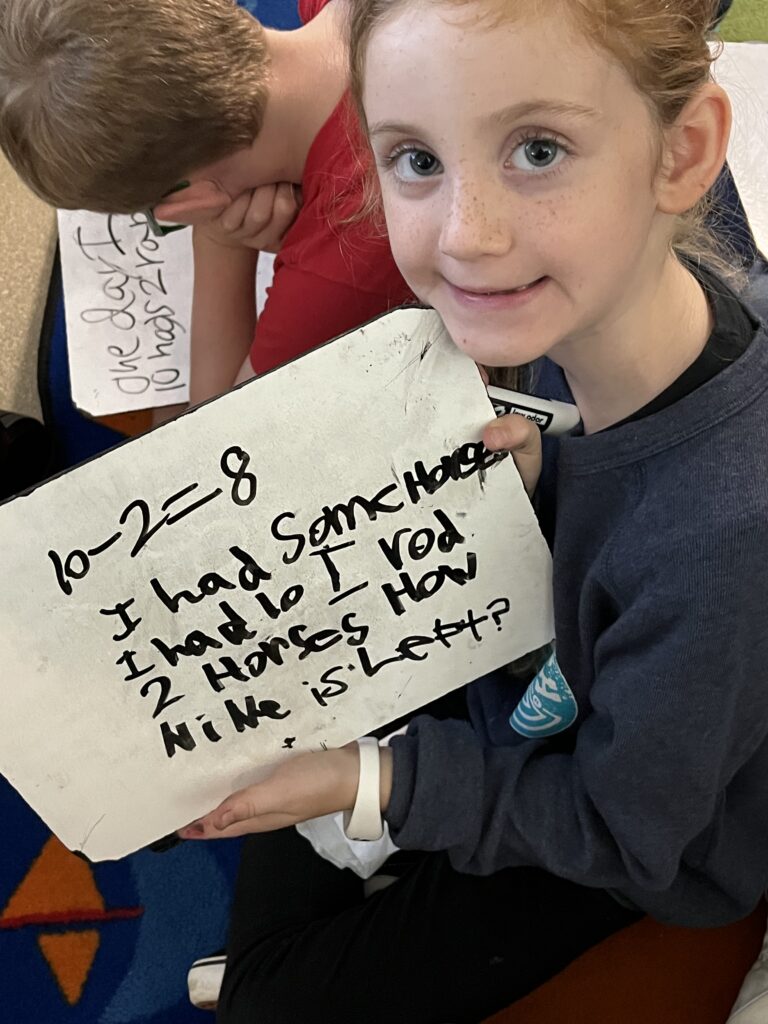
Every time that I am adding new information and I’m teaching them a new skill, then they’re going to add that to their whiteboard. So then after they’re doing that, I have them turn and tell. I teach them how to sit knee to knee and eye to eye.
And sometimes they switch boards depending on the time of year. I haven’t had them switch boards yet, but I have them share with their partner what they have illustrated, what they’ve drawn, and then their partner’s going to give them a thumbs up for a good job or thumbs down if they have something that is wrong. So if they have a thumbs down… I tell them that they have to tell them how to fix it.
So if they have a wrong number, they have the wrong sign, they give them a thumbs down and then they tell them how to fix it. For the really smart mathematicians, this is really, good for them because then they can justify and they can explain how they can fix their problem. So that is the beginning of my math block. And then after that, then I go into my lesson.
I teach them something new, the new skill. We have Blue Bonnet Math because I teach in Texas. Blue Bonnet Math is the new version of Eureka Math. So if you have Eureka Math, it’s very similar. So I have slides that we use for our lesson. And then after I do the slides, they’re sitting there with their whiteboard the whole time. But you have to train them.
If they play with their marker, if they’re tapping on their board, I will take away their marker, and then they have to sit there, and they can’t draw at all, or they can’t write at all. So I’m very strict about how they are using their marker, how they’re using their whiteboard. They have to sit it in their lap. And then after that, we go into stations. So I do a rotation and I’m sitting at my teacher table. And then I have an independent practice station. I have a math journal practice station, a math journal station. So, let’s get into some great math literature!
1.) The Button Box
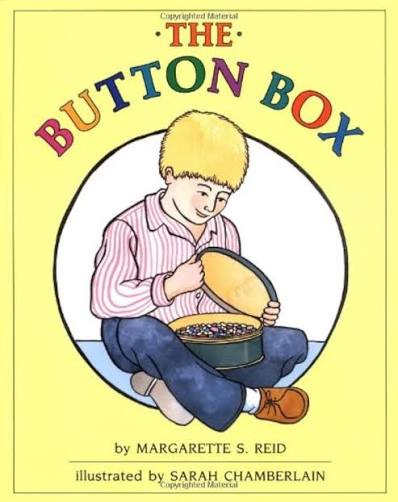
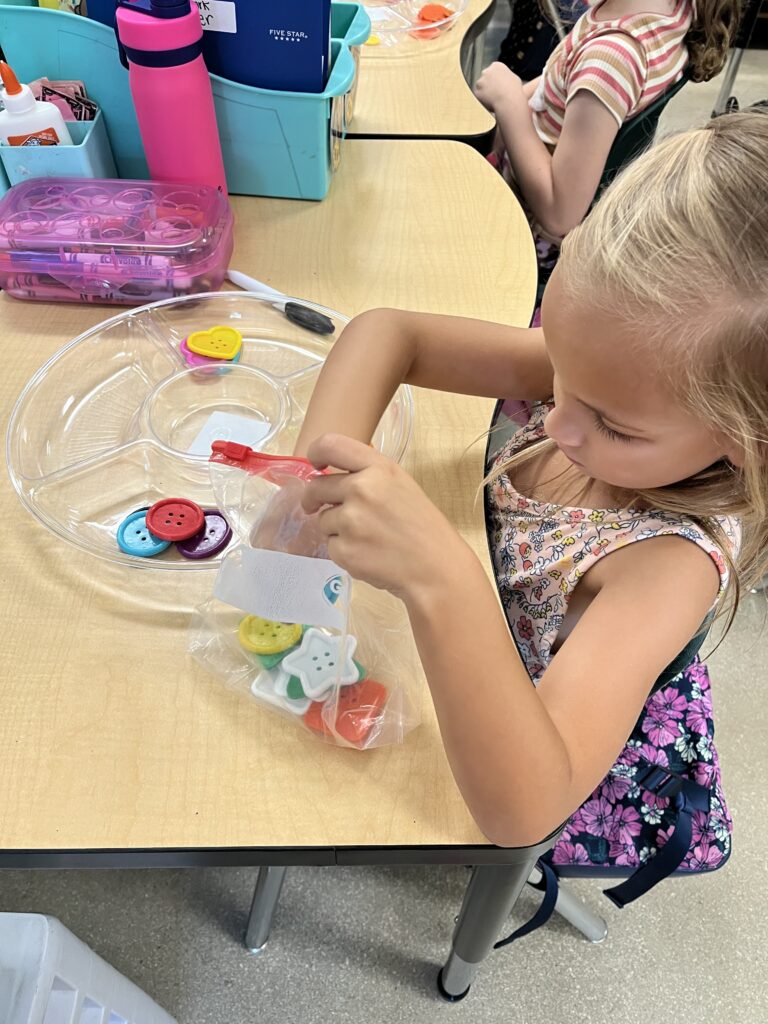
One of my favorite books I read to my kids during the first week of school is The Button Box. This book is really, really good for graphing and sorting. This was when I was introducing my independent practice as one of my stations. And I was introducing how to take care of manipulatives.
I use plastic chip trays from the dollar store, and I also ordered these big plastic buttons from Amazon, and they’re really awesome because they’re all different sizes, shapes, and colors. They’re not regular buttons, and they’re so fun and great for sorting and graphing!
If you’re interested in my Button Graphing resource, click HERE.
2.) Counting Gumballs
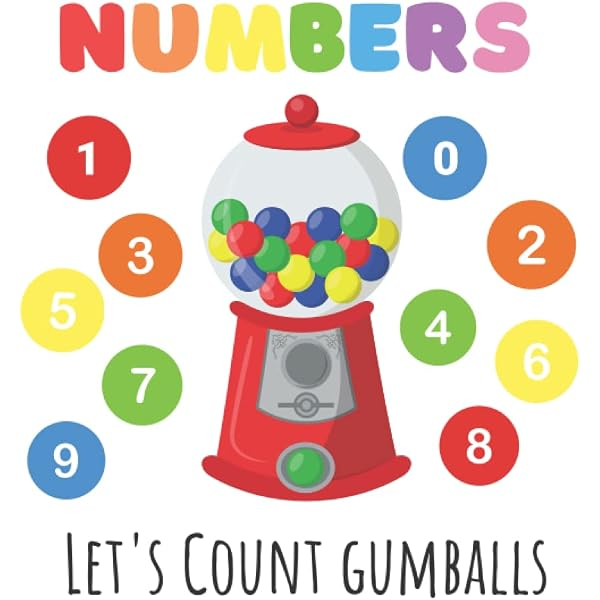
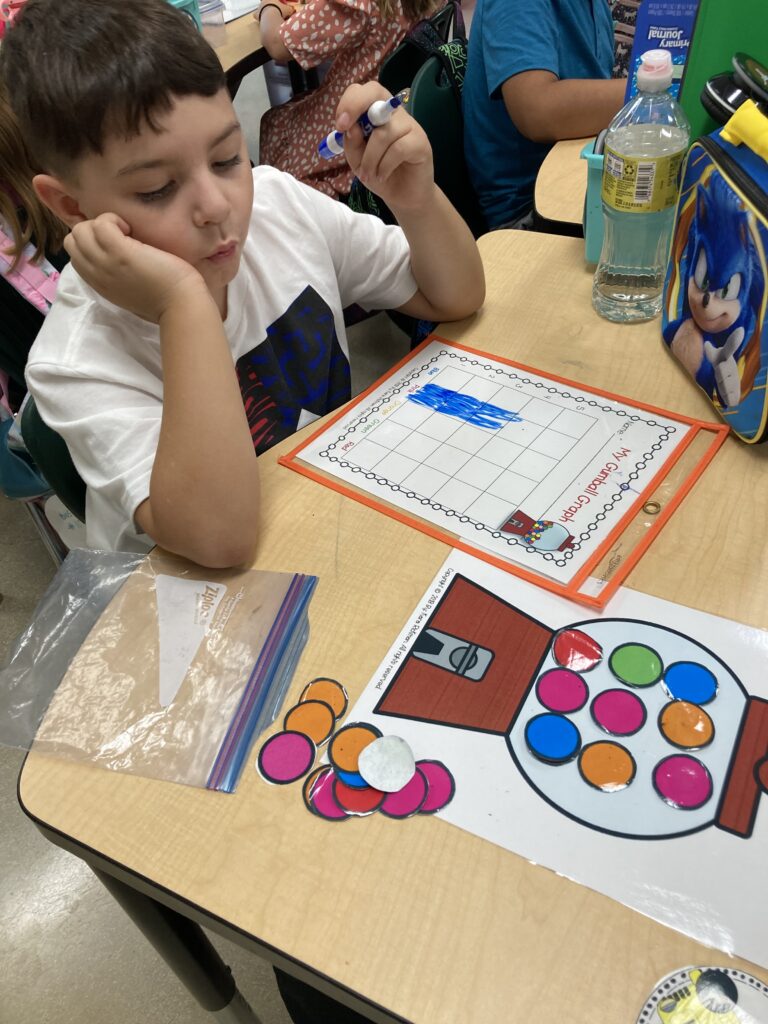
Number 2 is called Numbers: Let’s Count Gumballs. So this one is super fun. Again, the kids are sitting on their carpet, and they have their whiteboard, their marker, and eraser, and they’re writing down all the numbers that they hear from the story. So this is really cute. This could be used for kindergarten and first grade.
They’re writing down the numbers that they hear. If you teach second grade… I always tell them, you could tell them to add a zero to the number. Whatever number you hear, add a zero. So that will be 80 or 90, or 100. You could give them a gumball machine. And they are going to put on their gumballs. Now these are counters that you could use anything for this if you wanted to. You can use pom poms, small colored chips, or paper chips.
So they’re going to make their gumballs. Gumball machine and put all the different colors on here like that and then they’re going to color in how many blue gumballs they have, how many pink gumballs they have orange, green, red. So you could cut them out and laminate them if you want to give them like the paper ones. But I like to use like more hands-on counters.
If you’re interested in my Gumball Machine Graphing resource, click HERE.
3.) Apple Countdown:
Number 3 is Apple Countdown. I don’t know if you guys know this book by Joan Hulub. It is so fun. I read this book to my kids last week. So, it starts with 20. Starts with 20 apples, and then it goes down. It goes down from 20 to 19. I have my kids write down all of the numbers they hear in the story. 18. The kids in the story are going on a field trip. And then it talks about the different kinds of apples, like Red Delicious, Granny Smith, Macintosh, Golden Delicious. So they’re going to pick all their apples.
And it goes from 10, 9, 8, 7, 6, 5, 4, 3, 2, 1. So again, they’re writing down the numbers they hear. And then after the story’s over, I tell them to pick one of their favorite numbers on their whiteboard. And they draw a number bond. And then they write the number sentences to go with it. And then I show one of their whiteboards. I pick a whiteboard every day. I pick a different child. And I show the whiteboard to the class and then they get $5. And then we give them a compliment about their whiteboard. And every time I teach them a new skill, that new skill is also added to the whiteboard.
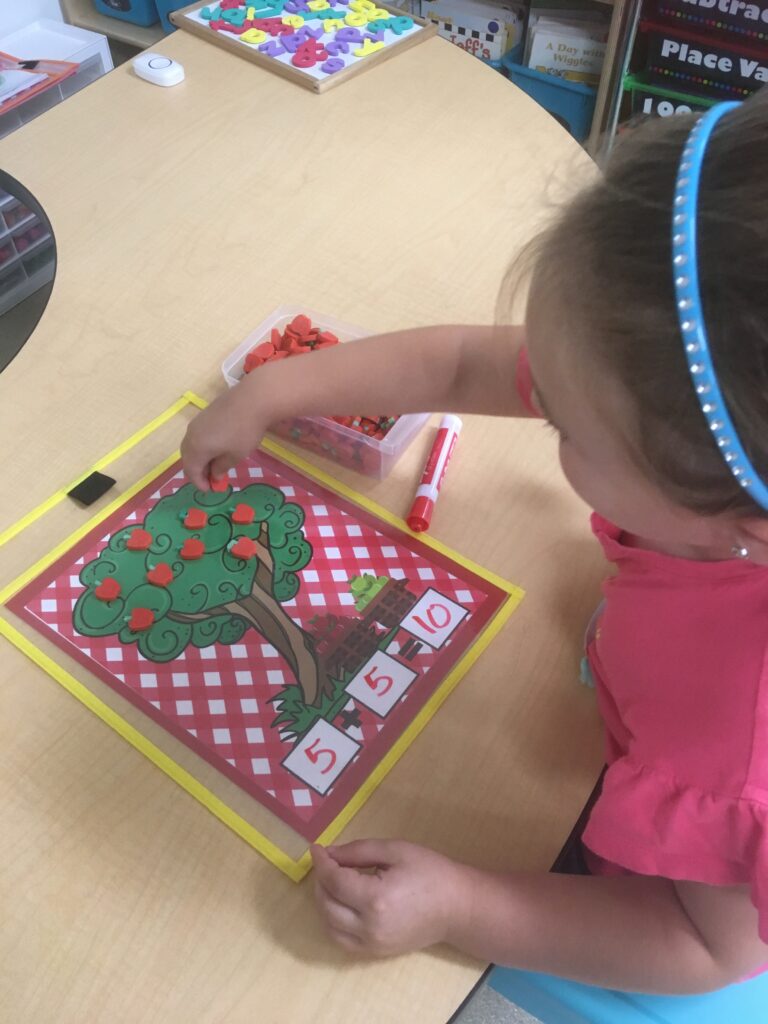
So this was an independent practice. It’s probably more manageable in your small group because then you only have four or five kids. So you give them 20 apples and then they can start with 20 and then they can take one away each time. And then they’re writing their number sentence down here. So they can start with 20 minus 1 equals 19.
And then 19 minus 1 equals 18. And every time that you’re reading a page of this, their Apple mat is matching the page. You could have them do that if you don’t want to have them sit with their whiteboard. So again, they’re listening to really awesome math literature. You’re asking them, are the numbers increasing or decreasing? And if they’re decreasing, how do you know?
If you’re interested in my Holiday Math Mats, click HERE.
4.) Trick or Treat Countdown
So now we have Trick or Treat Countdown. This is really fun. This is starts with it starts with one So one haunted house groans; two tall tombstones moan; three witches crackle; four dead leaves crackle. Now, this is really great for rhyming words, for poetry. So I teach my kids to listen for the rhyming words. So you’re bridging the gap.
Now you’re connecting poetry. You’re connecting literature and math all together. There’s so much learning that goes on. So fun and engaging! I ask: boys and girls, what do you notice in this story? And they say, ” Oh, there’s rhyming words, yay!” Okay, so something that you could do with this book when you’re reading this one is, again, they could write on their whiteboard if you want to do it whole group.
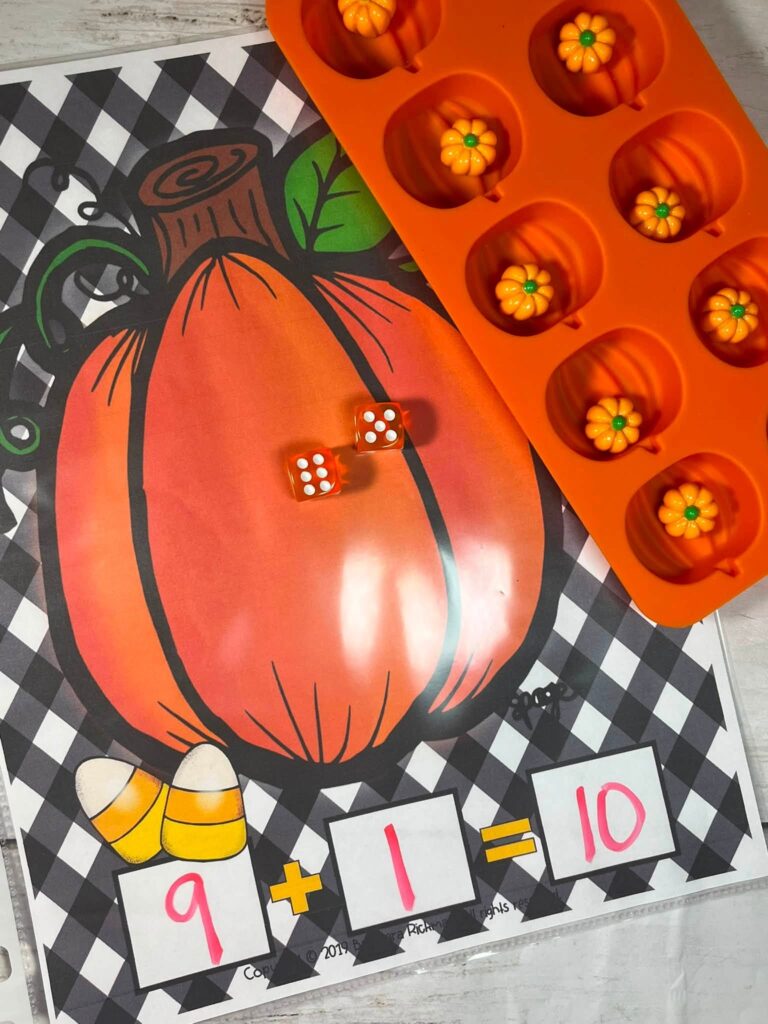
Or if you want to do small group, you can use this mat here. If you want to use the silicone tray. These are resin pumpkin counters, okay? So you can have them build. You can have them build the numbers here inside the silicone tray. So if you want to do this, again, you can do it small group if you want to.
So when you’re reading to them, you’re going to say one haunted house, and then they put one. two tall tombstones, then they’re gonna put two, and then they’re gonna build. You could also have them write their addition problems on here. You could have them write the addition problem, or you could have them put their counters on here, like this.
5.) Pumpkin Countdown
Another one is Pumpkin Countdown. This is by Joan Holub. This is the lady that also wrote the Apple Countdown one that I just showed you earlier. So again, these kids are going on a field trip. They’re going to the pumpkin farm. And so you could have them especially use the mat that has the subtraction on here. So they’re going to start with 20 pumpkins. Take away one each time that you’re reading the page.
Right? And then they can write their number sentence. You don’t have to do the whole book. You don’t have to do the whole book. You can do part of it. If you want to start with 10, you know, or you could do it two days. You can do part of it on the first day. and then part of it on the second day, okay? So you don’t have to do it all in one day if you don’t have enough time.
If you want to do it whole group, then you have the kids sit on the floor with their whiteboard, and then they’re writing down the numbers that they hear, okay? So again, you’re connecting your literature with your math, okay? And for this one, the numbers are definitely decreasing because they start with 20 and then they go down, okay? You want to ask them, how do you know the numbers are decreasing?
How do you know? And have them justify it. You could have them turn and tell. When they turn and tell, they’re sitting knee-to-knee and eye-to-eye. Having them switch whiteboards and rate each other really helps with rigor and relevance.
6.) Bat Jamboree
Alright, so this one is Bat Jamboree; you probably already know this book. Bat Jamboree is, it starts with 55, okay? So you might not want to give the kids 55 bats. Haha!
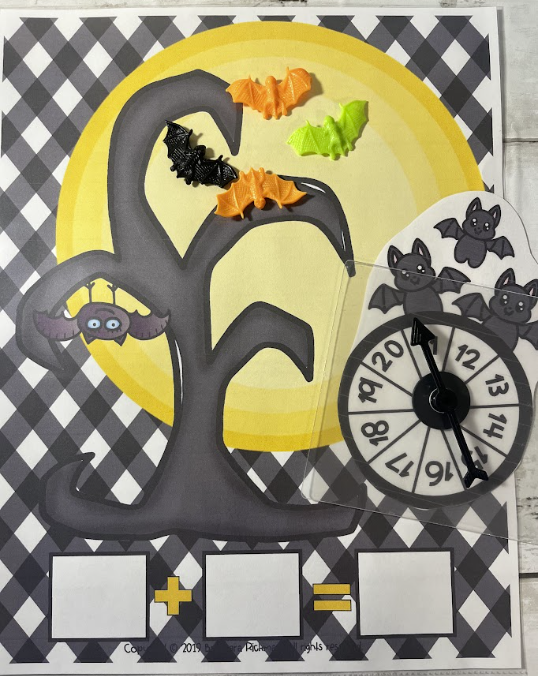
I mean, that would be really a lot, right? So for this story, I would have them write on their whiteboard. However, it starts with one, and then two, and then three, and then four, okay? So if you want to do it like that, you could have them make their bats. If you want to have them, here’s your bat mat, which is in the resource I uploaded for you guys. And then you could have them put their bats on here. And as you’re reading the story, they’re going to build with their bats.
Then it counts down it does a increasing and decreasing okay and then goes back down five four three two one. When the bat lady sings here and then it’s it stops with 55 again okay so at this point when you read this book you’re probably gonna be doing a little bit of place value, and you could have the kids draw a place value chart on their whiteboard, have them draw a T-chart with tens and ones. And then they can write five and five for 55.
If you’re interested in checking out my Bat Lit Kit Subscription Box with these bat activities, you can read about it HERE!
7.) 5 Little Bats Flying in the Night
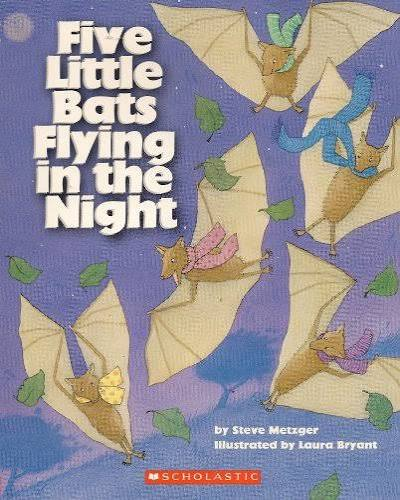
This is a spin-off of Five Little Monkeys Jumping on the Bed. So, five little bats flying in the night. One flew away far out of sight again. There are rhyming words again! The mother called the doctor, and the doctor said, ” No more bats flying in the night. So you’re going to start with five. You could do this in your small group: One, two, three, four, five.
Have them start with five bats. We have five minus one equals four. So they’re going to build it as you read it to them. So that would be really fun. This is really cute. And also it’s got rhyming words in here. And they love this story about mama called the doctor and the doctor said, you can sing it, you know, you can sing it together.
And it goes, it talks about fruit bats also. So it’s got a little educational tidbit to it here. So that’s really fun. So this is another really good book you could read during your bat unit for math.
8.) 10 Timid Ghosts
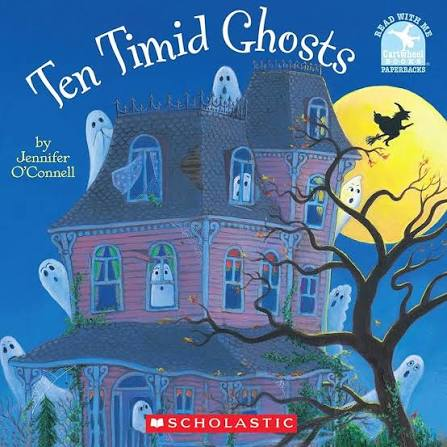
I think this is probably one of my favorite ones: 10 Timid Ghosts.
So here’s the mat, the haunted house and I’m going to start with 10 ghosts.
All right. So I have 10, my 10 ghosts right here. So, if you don’t know this book, it is super cute. There’s a witch that moves in the haunted house. Here’s the witch. She’s coming to take over.
“Ten timid ghosts in a haunted house. The witch moved in and wanted them out. One saw a skeleton and let out a whine. He flew to the woods, and then there were nine. ”
I’m taking one away. So, again, they can write their number sentences to match what the story is telling! So it goes all the way back down to zero. It goes all the way back down to zero. And the witch is getting all the ghosts out of the house. So each time one is going away.
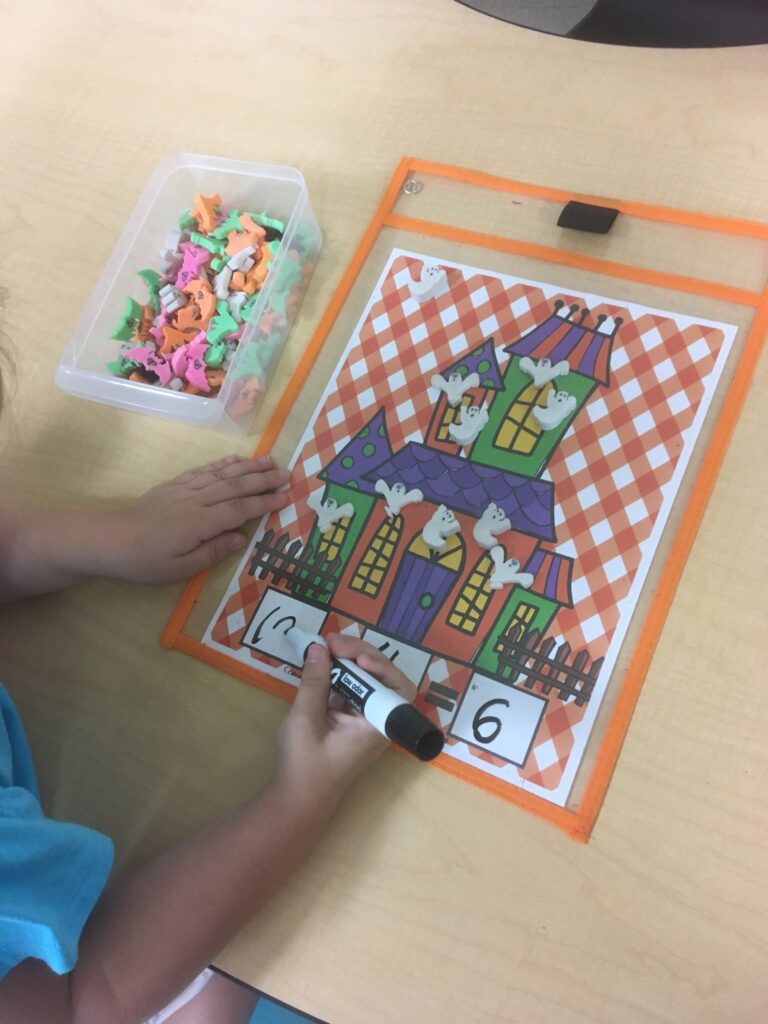
So then they all come back at the very, very end. They’re all back in the haunted house. They’re all 10 back again, and then she flew away. It’s really cute It’s so fun. And so it’s got rhyming words; also good for poetry too!
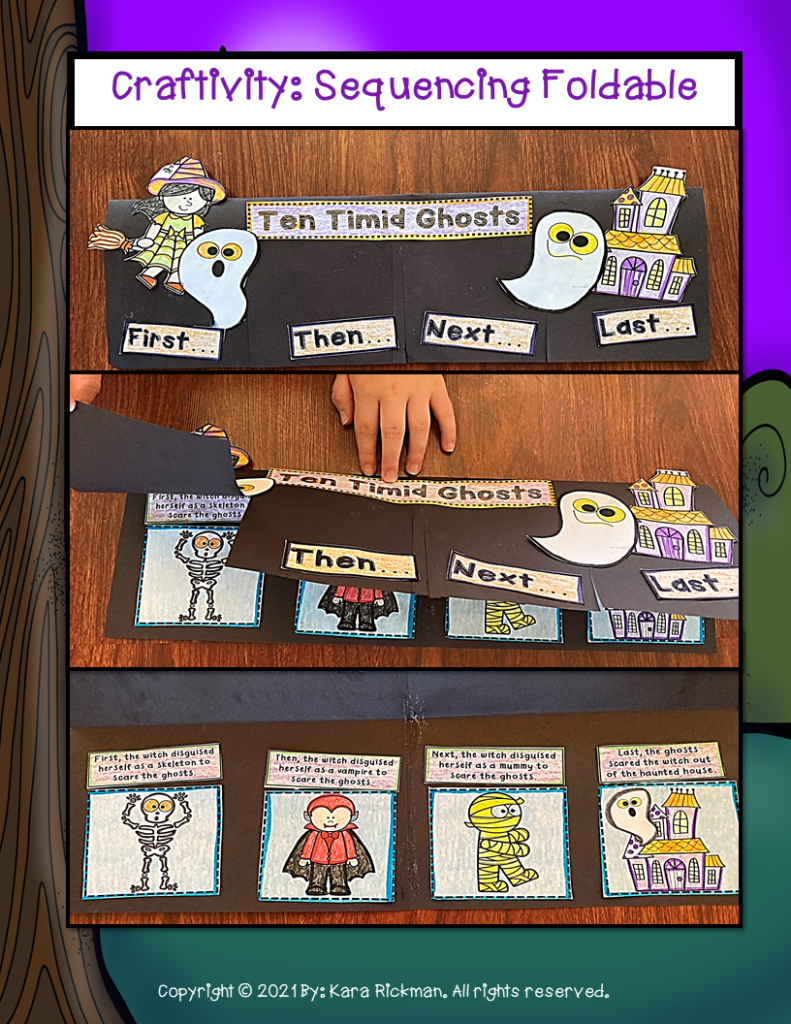
I also have what’s called a sequencing foldable and you could do this during reading time and then connect it with math also, so if you notice, it has the title. Then it has the pictures. It has first, then, next, last. This is really good for sequencing. In the resource, you have pictures that go in order of the story. So it says, first, the witch disguised herself as a skeleton to scare the ghost.
Then, the witch disguised herself as a vampire to scare the ghost. And then a mummy. And then last, the ghost… the ghost scared her and then she left, okay? So there are these pictures in the resource that you can have the kids color or there’s blank ones. The kids can color and make their own, okay? They can even write their own sentences if you want them to write their own. If you teach second grade and you want them to write their own, that’s fine. So this is in the file section for you guys, okay? Hope you have fun with this.
This is really fun. So what I do is I take a piece of one of those large pieces of construction paper and I fold it hot dog style, okay? I fold it in half like this and then I cut these four slits right here. There are four slits, and I cut them. So you can do this with any color. It doesn’t have to be black. I just use black because of Halloween. You can use any color that you want to. So that’s really, really fun. So 10 Timid Ghosts, if you don’t have this mentor text, you might want to get it. If you’re interested in my 10 Timid Ghosts resource, click HERE.
9.) Spookley the Square Pumpkin
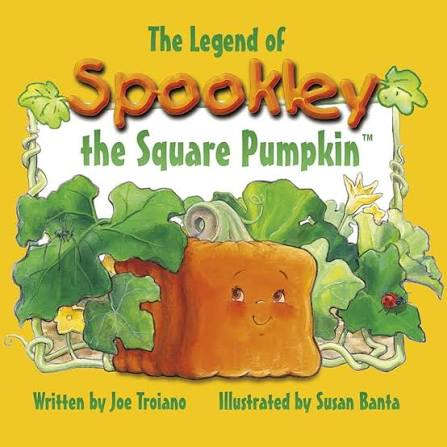
Now we’re going to go on to Spookley the Square Pumpkin. I know you guys all know this book. So since Spookley is a square, it’s perfect for math to talk about shapes. And also, this is a craftivity that I always use for Spookley. So I just took a really large piece of orange construction paper. I folded it so it’s like a tri-fold. And then I put a stem at the top with green curly tendrils.
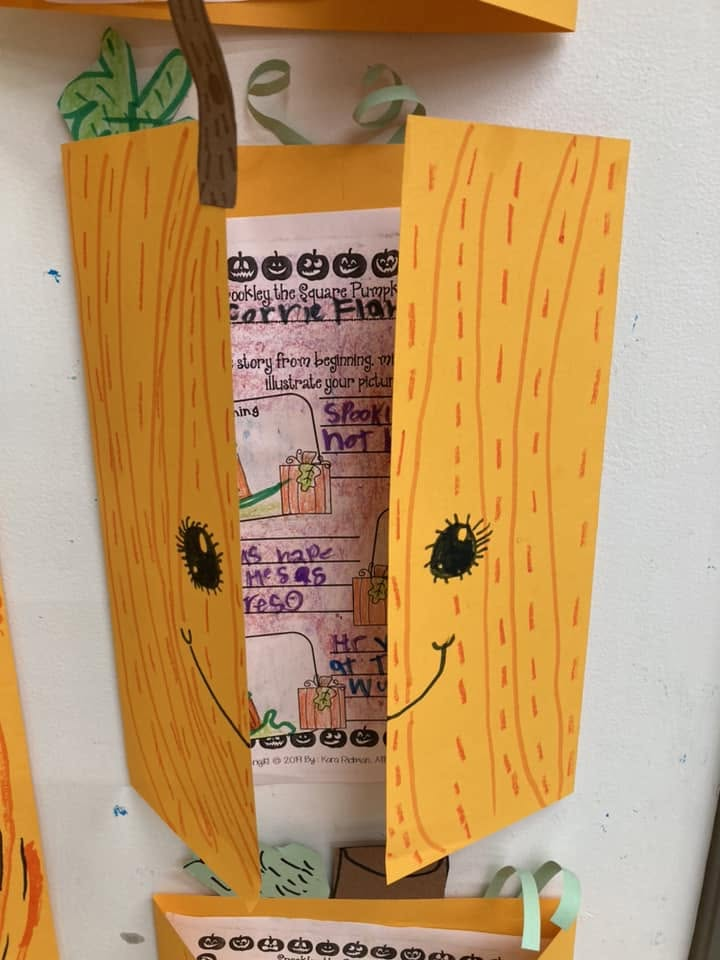
You’re going to teach them how to draw the face on the front, the two eyes and the mouth. So it’s symmetrical. You’re going to talk about symmetrical. So symmetry is also in math as well. So you’re going to draw Spookley’s face. Now, you can have them retell the beginning, middle, and end. It turns out really cute. And then I always hang it in the hallway.
So you could have them make the outside during math time. and then have them make the inside during reading time, okay, if you want to do it that way. So you can do it at different times of the day. If you’re interested in my Spookley resource, click HERE.
10. ) Stellaluna
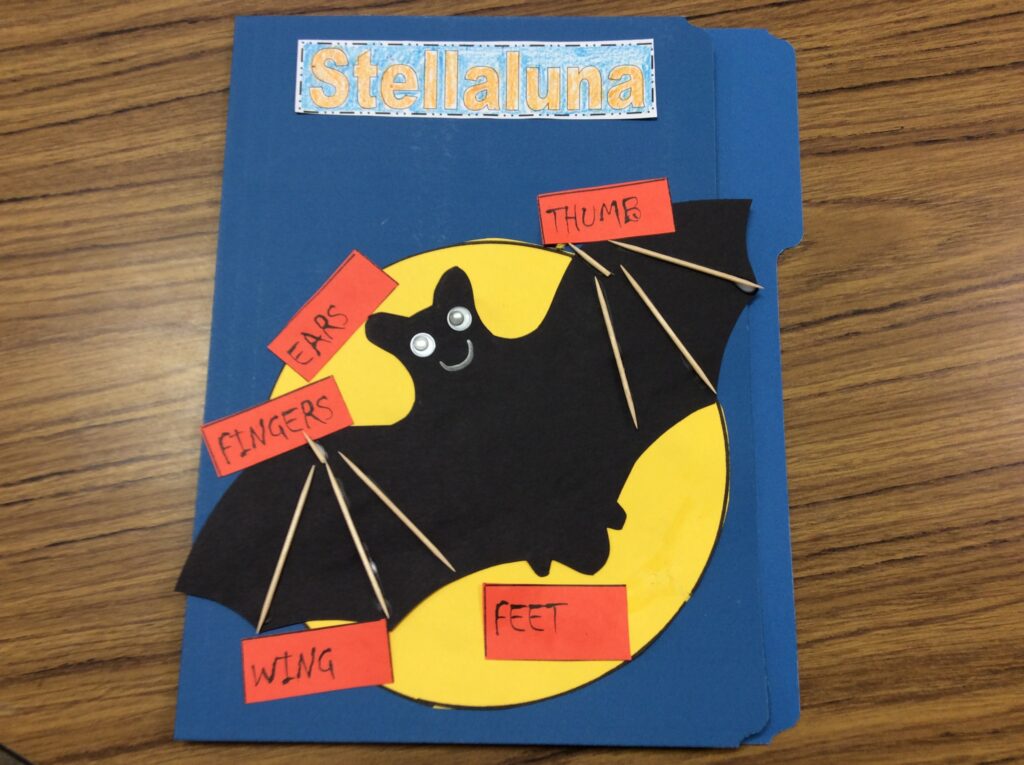
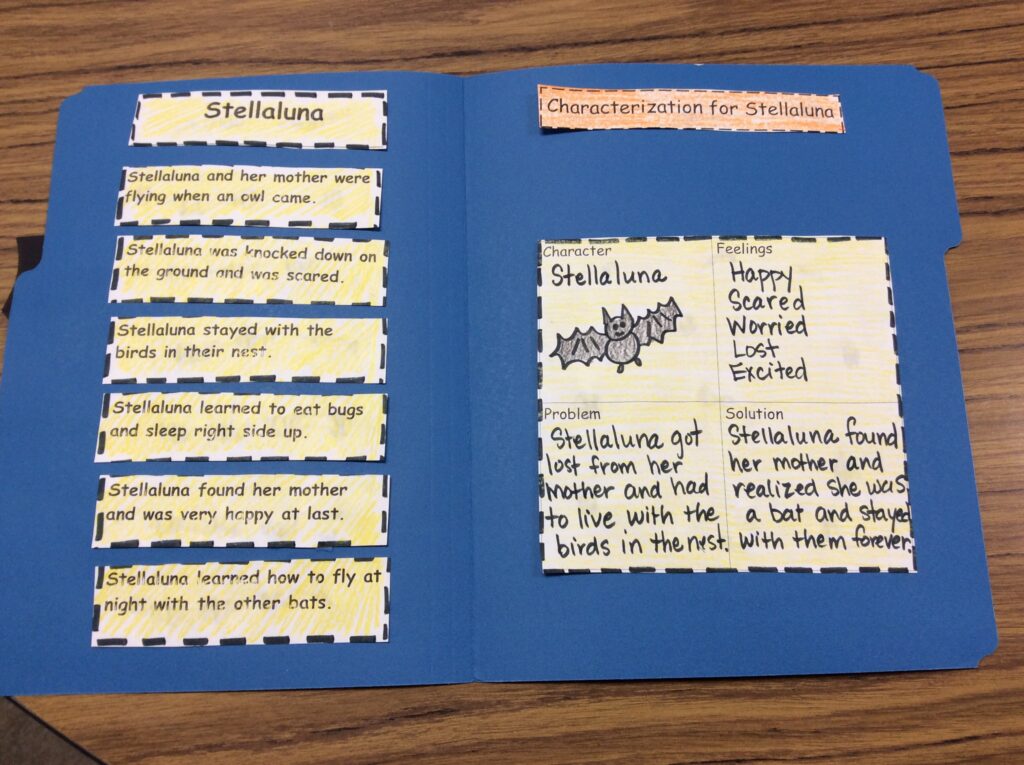
Then we’ve got to have Stellaluna, of course! I love making lap books. These are the colored folders that you can buy at Walmart or on Amazon. Now on Amazon, they have a whole box of the same color, and that’s what I do. I go on Amazon, and I order a box of 50, just blue folders.
Or you can do yellow or you can do orange or purple or pink. So you decide what color you want. They are going to label the parts of the bat: ears, thumb, feet and the wing. We glue the toothpicks on here to make her little fingers and her thumb. Then we glue googly eyes and the moon on the background. Then we’re gonna glue the title of the story Stellaluna. On the inside any templates that you want to do, for example, if you want to do a retell. This is also in the resource.
They’re going to color each part, and then they’re going to glue the story from the beginning, middle, and end. This is in sequence, okay? Now you’re going to have to do this whole group first. So you could put these, what I do is I put these little sentences on sentence strips. And then the class is going to help me put them in order. After I read them the story. You can also do characterization for Stellaluna. They’re going to draw the picture of the bat.
They’re going to write her feelings. How did she feel? What was her problem? And what was her solution? And then what you can also do is staple the pages. You can staple the pages in here and then they’re going to flip up. So you could do like three or four different pages in here. You can do the sequencing one.
You can do the characterization one. You can do parts of a bat. You can do a research page about bats. You can do a writing page about bats and just staple at the top so they can just flip the pages up. If you’re interested in my Stellaluna resource, click HERE.
11.) Bone Soup
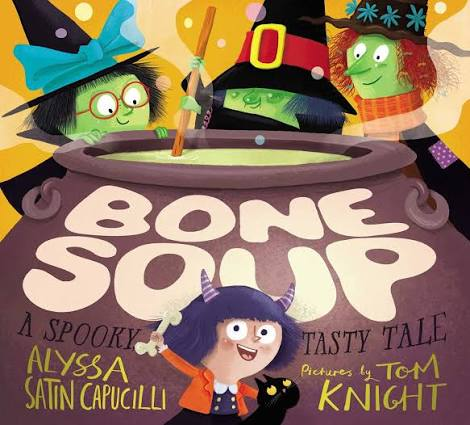
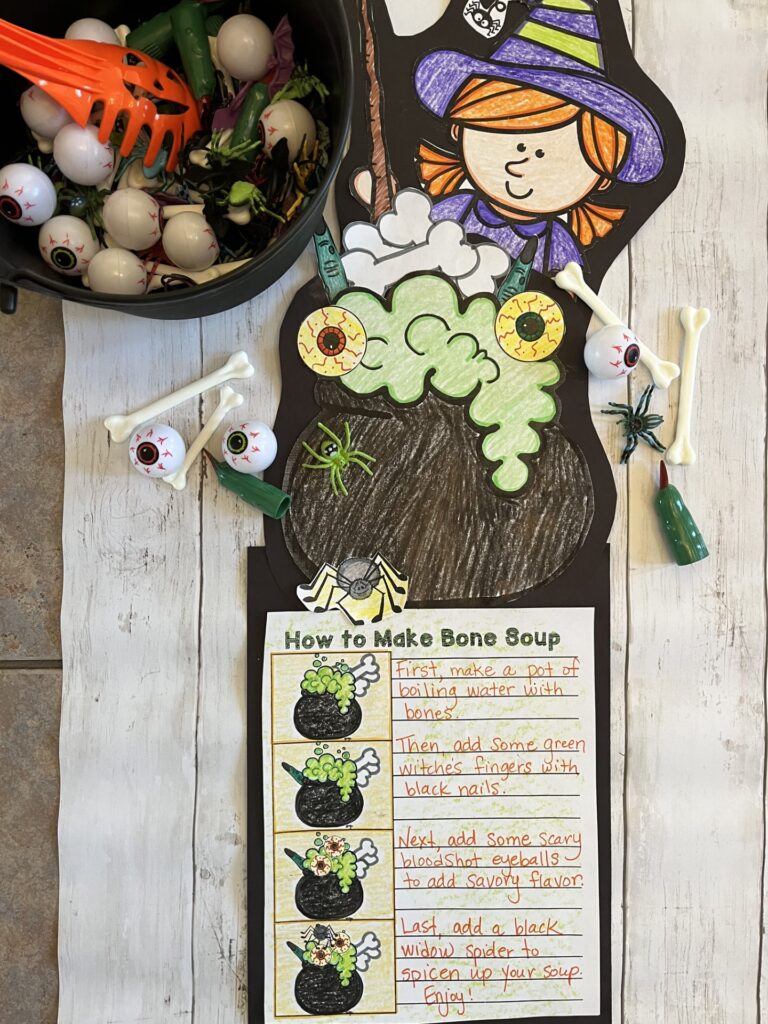
The last book is Bone Soup. Now, this one you can also connect with math as well; you can use this for graphing, for sorting, for counting, for adding and subtracting. So these witches are making their bone soup. The monster comes in. He tries to eat it. And they’re just adding all of these different ingredients. They’re adding toenails. They’re adding cobwebs. They’re adding prunes. They’re adding dead leaves.
So what you could do, you could have them do a sorting mat. I’ve got a little stirrer stick here. So what I did was I just went to one of those Halloween stores and I got a package of bones. Or you could do this at the Dollar Tree. I got a package of bones, a package of eyes, spiders, witch fingernails, little bats. There’s all kinds of stuff in here. But what you could do is you could add the ingredients and stir the ingredients while you’re reading the story too, or they could do it. And then you could have them sort the ingredients on their mat.
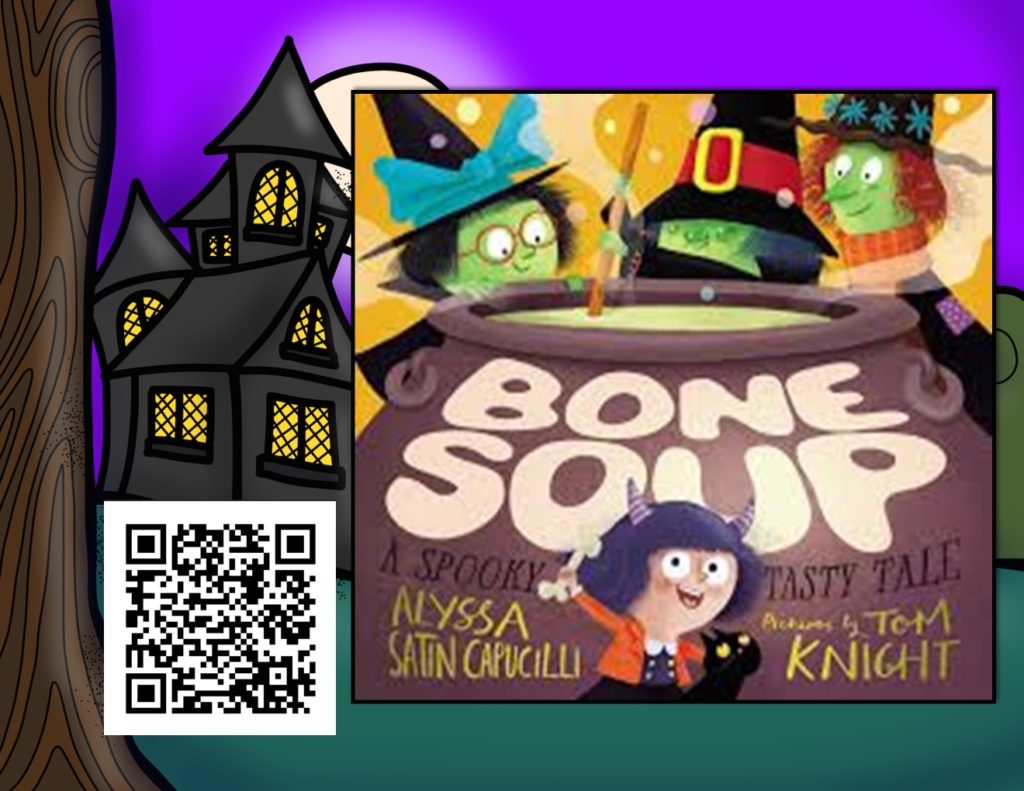
I also wanted to share my listening center. I make a QR code, and I print the cover of the story, and then I laminate it on a background. I make a QR code using Screencastify from the YouTube video, and the students can scan it with their iPad. It’s so easy! If you’re interested in my Bone Soup Resource, click HERE.
I hope you got some really great ideas of how to bridge the Gap Between Math & Literature today! If you’re interested in my Holiday Math Center Subscription Box, read about it HERE! It has more math games and math literature all in one box!